What Faux Flowers Look Most Realistic?
A faux stem can look either beautifully convincing or slightly disappointing from across the room. The difference is rarely about choosing the most expensive bunch. More often, it comes down to understanding what faux flowers look most realistic in the first place, and how they behave in a room with natural light, soft textures and everyday styling.
The most realistic faux flowers tend to share one quality - restraint. They do not try too hard. Their colours are slightly muted, their petals are imperfect, and their stems have a natural looseness that feels closer to a garden cutting than a showroom sample. If your home leans towards calm, layered interiors rather than bright statement décor, these details matter.
What faux flowers look most realistic in a home setting
Not every flower translates well into faux form. Some blooms are naturally structured and forgiving, while others rely on a softness or translucency that can be difficult to replicate. In most homes, the stems that look most believable are the ones with shape, texture and a slightly organic silhouette.
Hydrangeas are a strong example. Their clustered heads create fullness without each individual petal needing close inspection, which makes them one of the safest choices for a realistic arrangement. When done well, they bring softness and volume to a dining table, sideboard or hallway console, especially in cream, dusty green or muted blush.
Faux eucalyptus is another favourite because real eucalyptus already has a matte, dusty finish. That natural chalkiness is easy to mimic, and the slightly faded green tones sit comfortably in neutral interiors. It also works as a supporting stem, helping mixed arrangements feel less formal and more relaxed.
Blossom stems, particularly cherry or apple blossom, can also look very convincing. Their appeal lies in lightness. A branch with scattered flowers and delicate movement feels closer to something foraged from the garden. They suit taller vases and add height without heaviness.
Tulips are more divisive. Good faux tulips can be excellent because the flower itself is clean and simple, but poor ones look overly glossy and stiff. The most realistic versions have gently bending stems, soft-touch petals and a shape that looks slightly different from bloom to bloom.
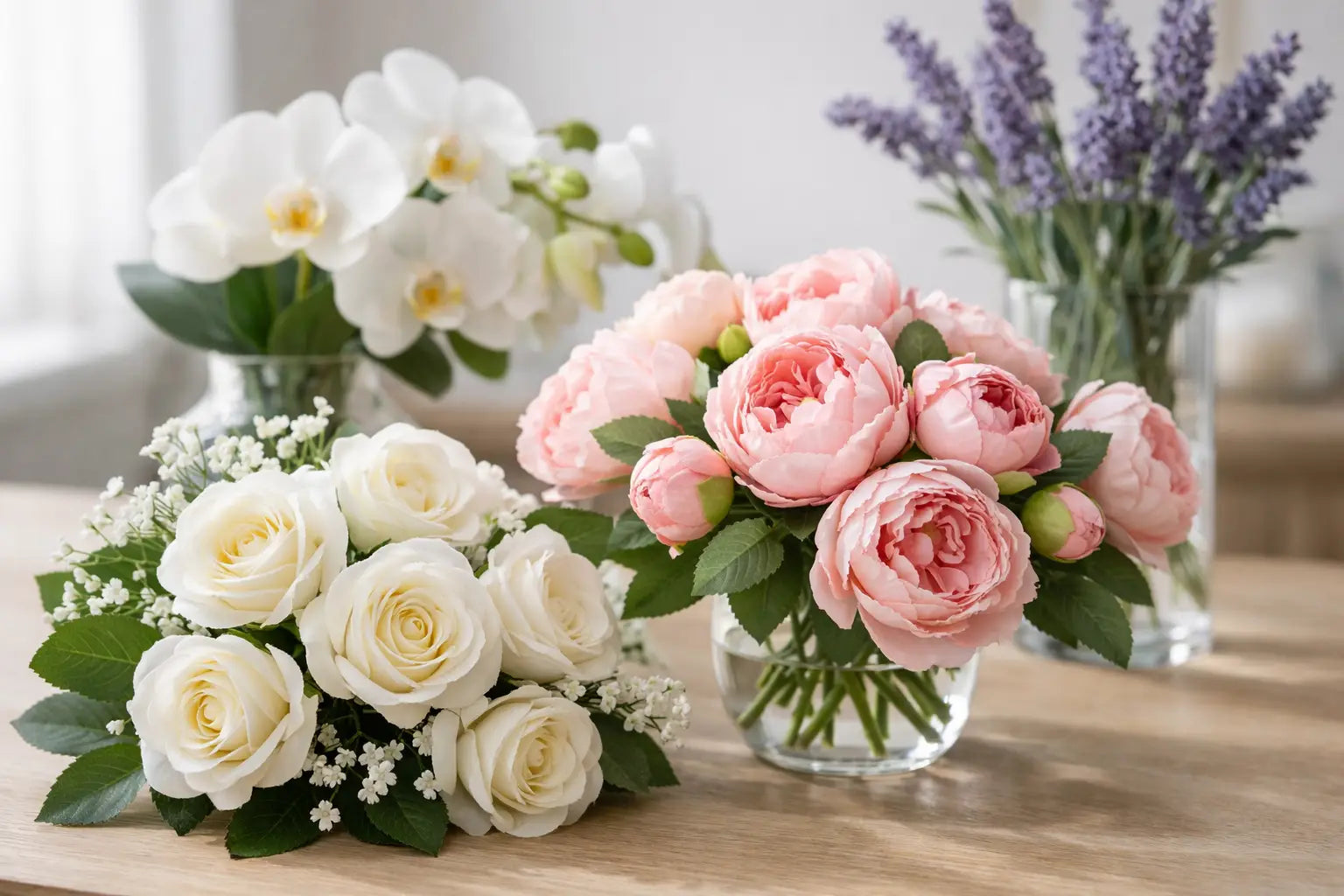
Roses can work beautifully, though they depend heavily on quality. A rose is familiar to almost everyone, so any plastic finish or unnatural petal curl is immediately obvious. Garden-style roses with layered, looser heads generally look better than tightly packed formal versions.
The materials that make the biggest difference
If you are deciding what faux flowers look most realistic, material matters as much as flower type. The best stems usually combine fabric, latex or coated finishes rather than relying on shiny synthetic surfaces.
Soft-touch faux flowers often have a more natural feel and appearance because the petals carry a subtle texture rather than a crisp, papery edge. Latex-coated petals can be particularly effective for tulips, orchids and roses, where smoothness is part of the flower’s character. Fabric petals work well when they are finely cut and gently shaded, not thick or frayed.
Stems are just as important. Realistic faux florals tend to have wired stems that can be shaped naturally, with a finish that resembles green bark or lightly mottled plant tissue rather than bright plastic. Leaves should vary slightly in size and angle. When every leaf sits in the same direction, the arrangement starts to feel manufactured.
Colour is often where realism is won or lost. Nature is rarely one flat tone. The most convincing faux flowers include soft variation - a darker centre, a faded outer petal, a hint of green near the base, or leaves with subtle veining. Gentle inconsistency is a good sign.
The flowers that tend to look less convincing
Some flowers are simply harder to recreate. Very delicate blooms with translucent petals, such as anemones or poppies, can be difficult to make believable unless the quality is exceptional. Likewise, heavily saturated flowers in bright purple, scarlet or cobalt often read as artificial more quickly than softer shades.
This does not mean you should avoid colour altogether. It simply means muted, natural-inspired palettes tend to feel more at ease in the home. Creams, soft pinks, olive greens, dusky mauves and warm whites usually blend more easily with wood, linen, ceramics and candlelight.
There is also a scale issue. Oversized flower heads can look impressive on a shelf or in a product image, but in a real room they may feel theatrical. Smaller, more thoughtfully proportioned stems often appear more realistic because they echo what you might actually gather or buy fresh.
What faux flowers look most realistic when styled well
Even the best faux flowers need thoughtful styling. A beautiful stem can look false if it is arranged too neatly or placed in the wrong vessel. Real flowers have movement, variation and a little asymmetry, so faux stems should be treated the same way.
Start with fewer stems than you think you need. Overfilling a vase can make an arrangement feel dense and uniform, whereas a looser display gives each stem space to fall naturally. This is especially effective with blossom, eucalyptus and longer meadow-style stems.
Choose a vessel that supports the mood of the flowers. A ceramic jug, textured vase or softly aged glass often suits faux florals better than anything too polished or ornate. The aim is not to create a perfect showpiece, but something that sits easily within the rest of the room.
Bend the stems. This small step changes everything. Straight stems with identical heights rarely look natural. By adjusting the angle and spacing, you create the kind of irregular silhouette fresh flowers have without trying.
Mix flower types carefully. A single variety can be striking, particularly with hydrangeas or tulips, but mixed arrangements often look most realistic when they combine one focal bloom with supporting foliage. Too many statement flowers competing together can feel decorative rather than natural.
The best faux flowers for different rooms
Realism also depends on context. What looks right in a hallway may not feel right on a bedside table.
In the kitchen, faux herbs, eucalyptus and simple tulips tend to work well because they echo the relaxed practicality of the space. They feel fresh without becoming fussy. On a dining table, hydrangeas, roses or mixed seasonal stems can create softness and occasion, especially when paired with candles and natural tableware.
For hallways or entry consoles, taller blossom branches or fuller foliage arrangements bring height and presence. In bedrooms, gentler stems such as peonies in soft neutrals or a small bundle of dried-look florals usually feel calm and understated. The most convincing display is one that suits both the room and the season.
Seasonal choices that still feel timeless
One reason faux flowers are so appealing is that they can shift your home gently through the seasons. The key is choosing stems that still feel aligned with a timeless interior rather than a short-lived trend.
In spring, blossom, tulips and soft green foliage bring lightness. Summer suits garden roses, hydrangeas and wild-looking meadow stems. Autumn works beautifully with muted berries, seed heads, eucalyptus and foliage in earthy tones. For winter, white berries, evergreen stems and understated festive wreaths can add warmth without overwhelming the space.
This is where choosing carefully makes a difference. A well-chosen faux arrangement should not feel like a seasonal prop. It should feel like a natural extension of your home, with just enough change to keep things feeling fresh.
How to spot quality before you buy
If you are shopping online, look closely at the details in product photography. Petal edges should appear soft rather than sharply cut. Colour should vary subtly across the bloom. Leaves should not look overly thick or glossy. Arrangements photographed in natural interiors often give a better sense of scale and finish than isolated product shots.
It also helps to think in stems rather than bunches. Buying a few individual stems can create a more believable result than one pre-made bouquet, because you can shape and layer them yourself. That approach feels more personal too, which suits homes that are designed with intention.
At Sable Homeware, the most successful faux florals are always the ones that feel quietly at ease among ceramics, candles, woven textures and soft seasonal styling. They do not ask for attention. They simply make a room feel more complete.
The most realistic faux flowers are the ones you stop noticing after a moment, because they belong there so naturally.