How to Style Faux Flowers for Vases
A vase can change a room in seconds, but only when what sits inside it feels deliberate. Faux flowers for vases work best when they look as though they belong there - not stiff, overfilled or overly polished, but soft, natural and quietly finished. The difference is rarely the vase alone. It is the balance between shape, stem choice, colour and placement.
For homes that lean towards warmth, texture and a more timeless kind of styling, faux flowers offer something especially useful. They bring softness without maintenance, structure without fuss, and a sense of season that can be adjusted as your space changes. When chosen well, they do not read as a substitute for fresh flowers. They read as part of the room.
Why faux flowers for vases work so well
Fresh flowers are lovely, but they are also fleeting. There is the regular trimming, the changing water, the drooping heads after a few days, and the occasional panic purchase before guests arrive. Faux stems solve a different styling need. They create consistency.
That makes them particularly effective in spaces that benefit from a settled, finished look - an entrance console, a bedside table, open shelving, a dining table or a kitchen island. A vase with well-styled faux stems adds height, movement and texture, but it stays exactly where you want it. For many homes, that ease matters as much as the appearance.
The key is choosing stems with a natural silhouette and using them with restraint. Too many faux flowers can look formal or heavy. The more relaxed approach is usually the better one, especially in neutral interiors where each piece needs room to breathe.
Start with the vase, not the flowers
It is tempting to fall in love with a stem first, but the vase should lead the arrangement. Its height, neck width, material and shape all affect how the flowers will sit.
A tall narrow vase suits longer stems with a little natural lift, such as blossom branches, eucalyptus or single-headed florals with space between each stem. A wider vessel can carry fuller arrangements, though it still needs structure. Low rounded vases tend to look best with fewer stems, shaped outward rather than packed upright.
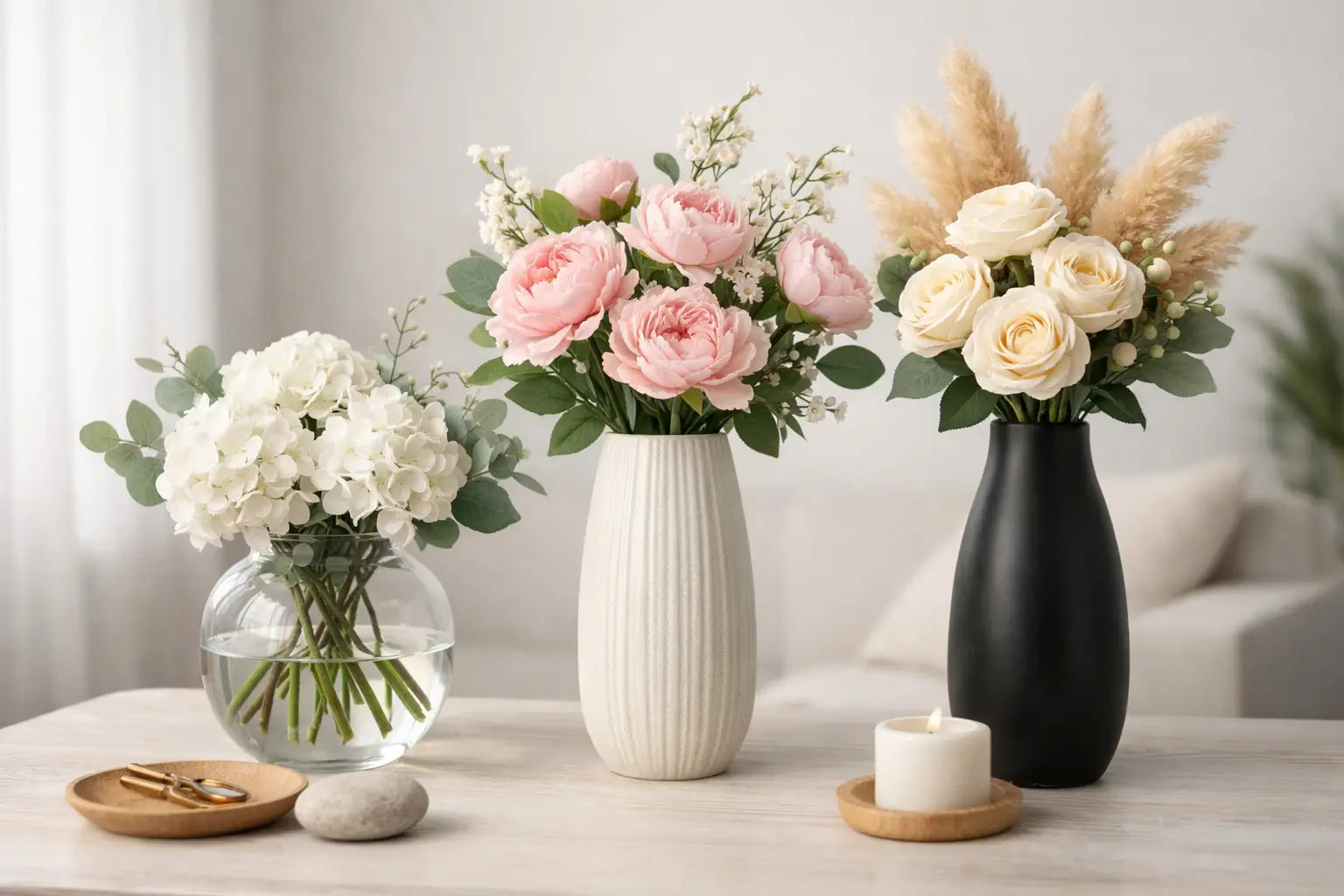
Material matters too. Clear glass feels lighter and more understated, which suits delicate or airy stems. Ceramic and stoneware bring softness and weight, especially in chalky neutrals, warm whites and textured finishes. If your room already has plenty of visual detail, a simpler vase often creates the calmest result.
This is where styling becomes more intuitive. Rather than asking what flowers look pretty, ask what arrangement your vase wants to hold.
Choosing faux stems that look natural
Not all faux flowers are equal, and the most convincing arrangements tend to share the same qualities as good interiors styling generally - subtle colour, tonal variation and shape that is not too perfect.
Look for petals with soft edges rather than a waxy finish, leaves with gentle colour shifts rather than one flat green, and stems that can be bent and shaped easily. Movement is what makes an arrangement feel believable. If every stem stands at the same height and angle, the eye notices immediately.
For a more timeless home, muted florals usually sit more beautifully than bright, high-contrast shades. Creams, soft greens, dusky pinks, faded mauves and earthy tones tend to work well with natural wood, linen, rattan and neutral ceramics. If your space is already layered with texture, a quieter floral palette will feel more refined.
It also helps to think in categories. Blossoms and branches create height and airiness. Greenery adds softness and space between focal stems. Fuller flowers such as hydrangeas or peonies bring volume, but they need careful handling. One or two generous stems can look elegant. Six can feel far too dense.
How to arrange faux flowers for vases
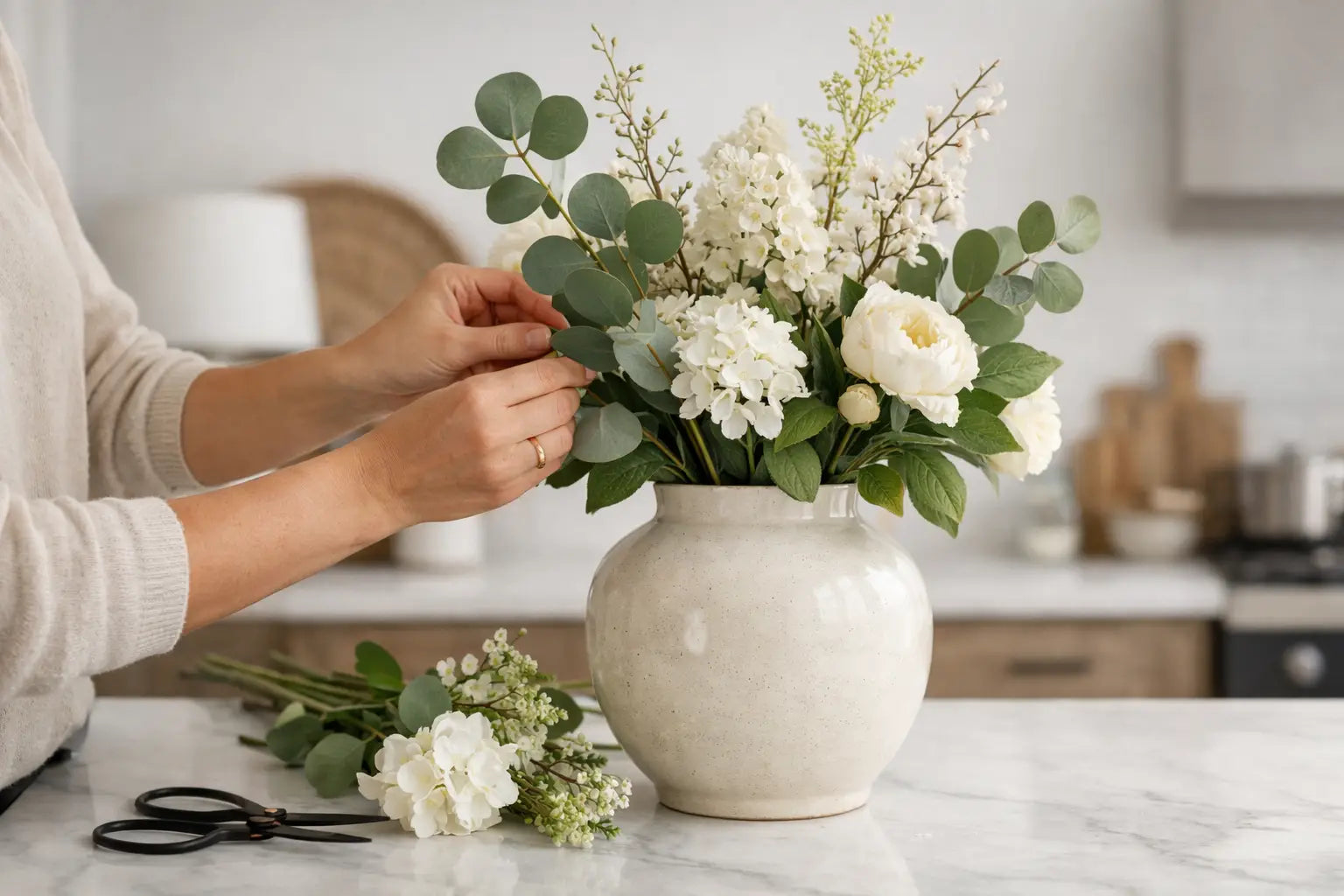
A natural-looking arrangement rarely starts symmetrical. Begin with one or two anchor stems to establish height and direction. Then add supporting stems around them, turning the vase as you go so the shape works from different angles.
Bend the stems slightly to avoid a straight-up cluster. Let some sit lower, some lean outward, and some cross gently through the centre. Real flowers are irregular, and the best faux arrangements borrow that looseness.
Negative space is just as important as the flowers themselves. Leaving small gaps between stems allows each one to be seen. It also keeps the overall look lighter, which is especially useful if you want the arrangement to feel calm rather than styled within an inch of its life.
If the stems are too tall, trim them with wire cutters or fold the lower part inside the vase if the material allows. Tall stems forced into a small vase often create tension in the wrong way. The proportions should feel easy.
As a guide, the total height of the arrangement can be around one and a half to twice the height of the vase, though that depends on the room and the stem style. Branches can go taller. Rounded florals usually look better a little lower and fuller.
Matching flowers to the room
Different rooms ask for different arrangements. A dining table needs something that adds softness without blocking conversation. In that setting, lower vases with looser stems often work best. Think gentle greenery, small blossom branches or a few well-placed flowers with a soft silhouette.
An entrance table can carry more height because it is usually viewed in passing. This is a good place for taller faux stems in a ceramic vase - something that gives the area an immediate sense of finish when you walk through the door.
In the bedroom, quieter arrangements tend to feel most restful. A simple vase with a few delicate stems on a chest of drawers or bedside table can add warmth without making the space feel busy. In bathrooms, where fresh flowers often struggle, faux options are especially practical. A small arrangement can soften hard surfaces and bring a more finished feel.
Kitchens sit somewhere in the middle. They benefit from arrangements that feel fresh but not precious. Greenery, herbs or loose meadow-style stems often suit this room better than anything too formal.
Seasonal changes without a full reset
One of the nicest things about faux flowers is the ability to shift the mood of a room with very little effort. You do not need to redesign the whole space. A vase swap or a change of stems can be enough.
In spring, blossom branches, soft tulips and fresh green foliage bring a lighter feel. Summer suits looser arrangements with a just-gathered look. Autumn often calls for deeper tones, seed heads, berries and textured leaves. At Christmas, the look can become fuller and more layered with evergreen stems, but restraint still keeps it elegant.
This is where a deliberate approach matters. Seasonal styling is most beautiful when it still feels like your home. The flowers should shift the atmosphere slightly, not compete with everything else in the room.
Common mistakes that make faux florals look less convincing
The first is overfilling the vase. More stems do not necessarily create a better arrangement. They often make it look bulky and artificial.
The second is choosing flowers that are too bright or too uniform in colour. Natural-looking faux florals usually have some tonal variation. A little fading, softness or irregularity helps.
The third is forgetting the stem shape. Even lovely faux flowers can look unconvincing if they are left straight from the packaging. A few minutes of shaping makes a remarkable difference.
Finally, consider scale. Tiny flowers in a large statement vase can feel lost. Equally, oversized blooms in a petite vessel can look awkward. When the proportions are right, the arrangement feels effortless, even if it has been carefully adjusted.
A more thoughtful way to finish a room
Faux flowers are sometimes dismissed when they are treated as filler rather than styling pieces in their own right. But when they are chosen with care, they bring something genuinely useful to a home - softness that lasts, colour that does not overwhelm, and a finishing touch that helps a room feel complete.
That is why faux flowers for vases continue to work so well in calm, layered interiors. They are not about excess or imitation. They are about creating a space that feels settled, welcoming and easy to live with. Whether you prefer a single branch in an earthenware jug or a fuller arrangement on the dining table, the most beautiful result is usually the one that looks unforced.
If you are updating a room, start small. One well-shaped vase, a few carefully chosen stems, and a little attention to proportion can be enough to make the whole space feel more complete.