How to Arrange Faux Stems at Home
A vase of faux stems can change the feel of a room faster than almost any other styling piece, but only when it looks relaxed rather than overly arranged. If you have ever bought beautiful stems and then found yourself shifting them around for ten minutes only to end up with something stiff and unconvincing, the good news is that learning how to arrange faux stems is much simpler than it seems.
The difference usually comes down to shape, spacing and restraint. A thoughtful arrangement does not need to be full or formal. In many homes, the most beautiful faux florals are the ones that feel airy, softly structured and in keeping with the room around them.
How to arrange faux stems for a natural look
Before you place a single stem in a vase, take a moment to think about where the arrangement will live. A kitchen shelf, console table, bedside or dining table each asks for something slightly different. On a dining table, you will usually want lower, looser stems that do not interrupt sightlines. On a hallway console, extra height can work beautifully because the arrangement is there to greet the eye.
This is where many arrangements go wrong. People often start with the stems themselves, when in fact the vase, the surface and the room should guide the shape. A narrow-necked ceramic vase naturally creates more structure, while a wide glass vessel needs more support and a little more intention to avoid stems splaying too far apart.
When the setting feels calm and cohesive, the stems are much easier to style. Neutral interiors often suit faux greenery, blossom or muted florals with soft movement rather than bright, highly polished blooms. If your home leans natural and understated, choose stems that echo that mood through texture and tone.
Start with the right vase
The vase does more work than most people realise. If it is too tall, short stems can look lost. If the opening is too wide, the arrangement can flatten out and feel sparse. A good rule is to choose a vase that supports the stems rather than fights them.
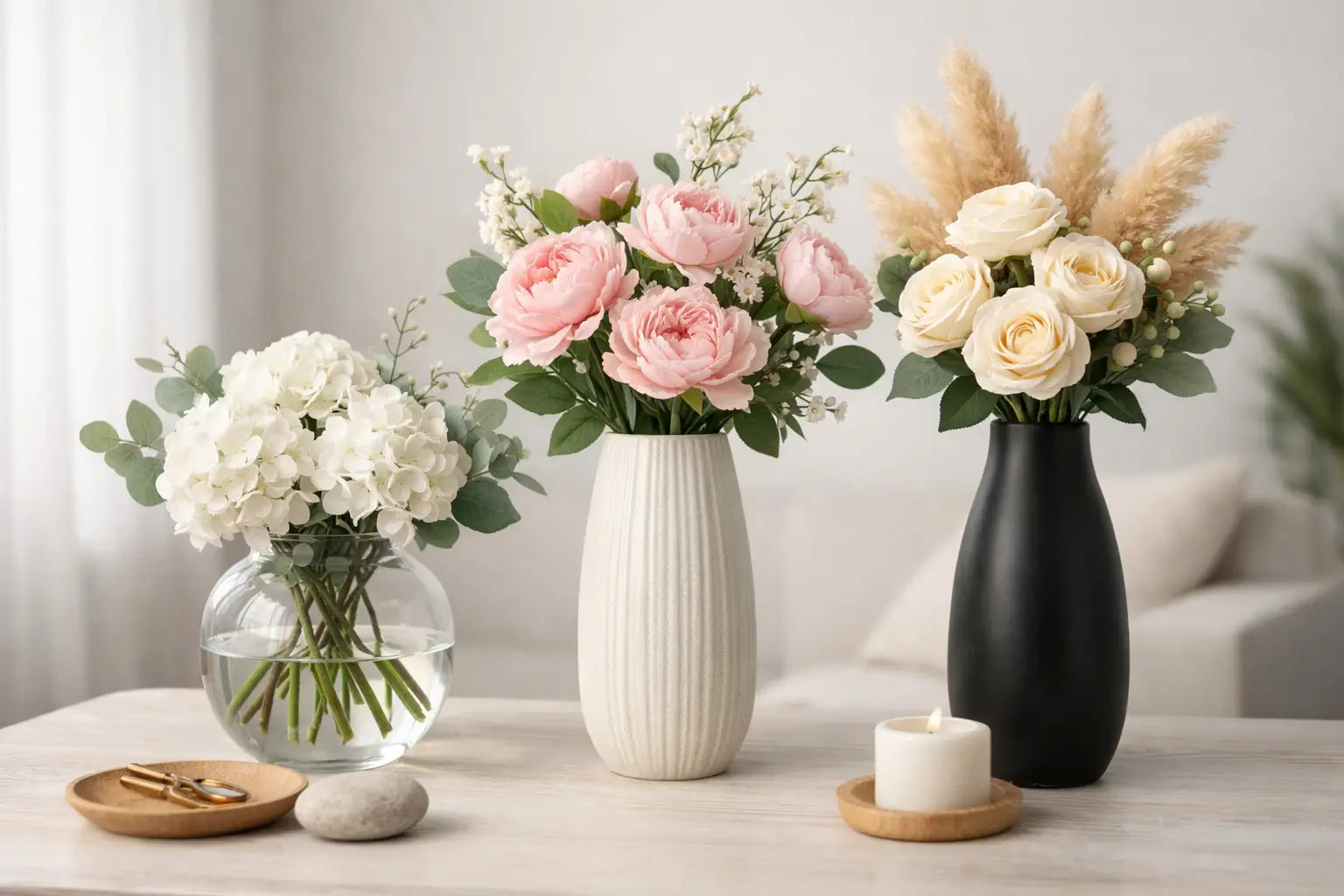
For fuller faux stems such as hydrangeas or eucalyptus, a vase with a narrower neck helps keep the shape gathered and elegant. For single branches or blossom stems, a taller vessel with a little weight at the base adds balance. Ceramic, stoneware and lightly textured glass tend to work especially well in softer interiors because they do not compete with the arrangement.
If you are styling a shelf or sideboard, consider the vase as part of the wider composition. A matte neutral vase with sculptural lines can make even a simple handful of stems feel deliberate.
Bend the stems before styling
One of the easiest ways to make faux florals look more realistic is to stop treating them as straight lines. Fresh stems naturally curve, dip and lean towards the light. Faux stems often arrive too upright, which is why they can look rigid in a vase.
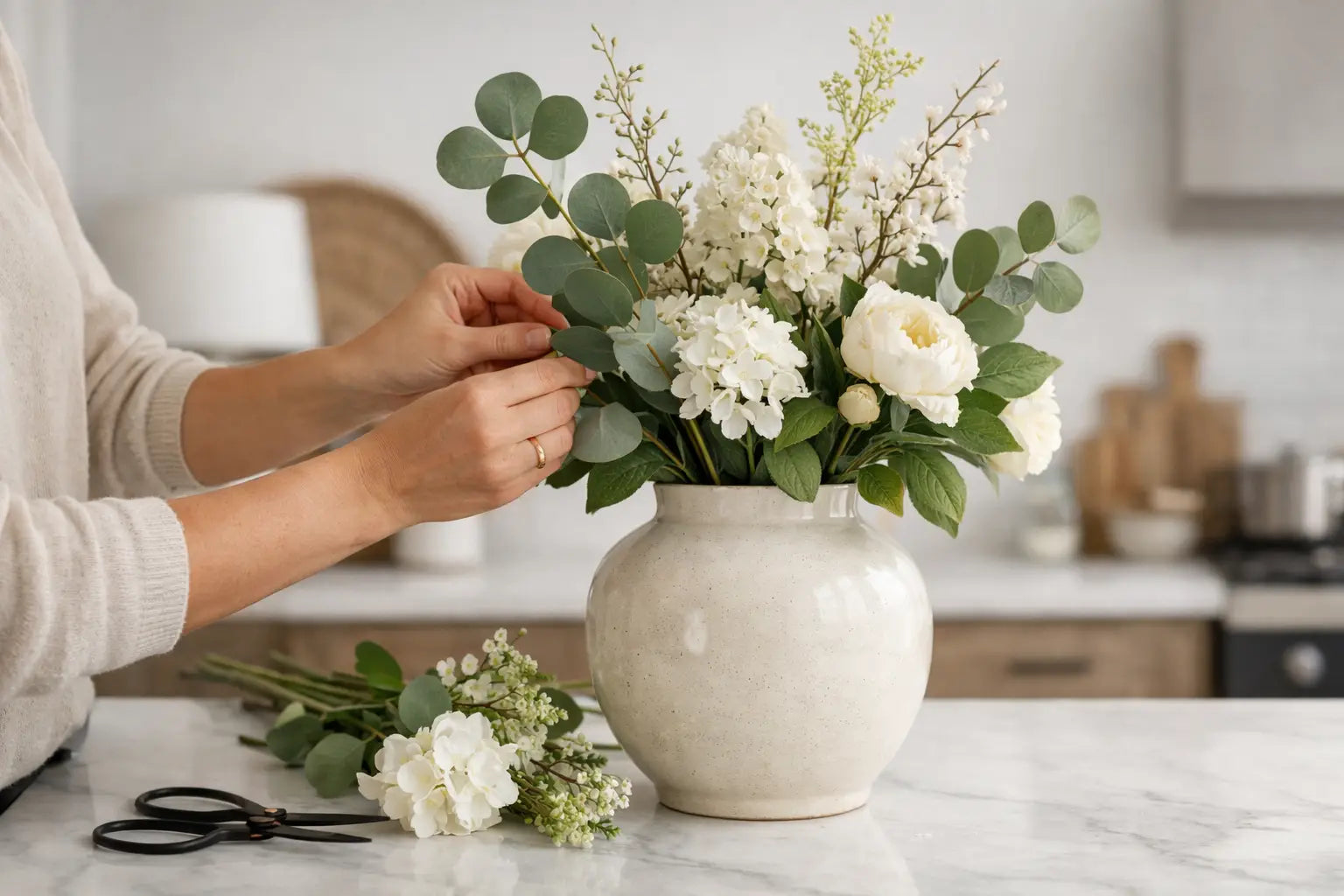
Gently bend the wired stems at different points to create a more organic silhouette. Some can stand taller, while others should sit slightly lower or angle outward. Avoid making every stem the same height. Variation is what gives the arrangement ease.
This is especially useful if you are arranging faux greenery. Eucalyptus, olive branches and leafy stems look far more convincing when they have a little looseness and movement. The aim is not perfection. It is a shape that feels believable.
Build the arrangement in layers
A well-styled arrangement usually has a simple internal structure, even if it looks effortless from the outside. Start with your tallest or most architectural stems first. These create the outline and establish height. Then add softer or fuller stems through the middle to give body.
If you are using mixed stems, think about them in the same way you might style a room. You need shape, texture and a little contrast. Too much of one element can make the display feel flat. A few delicate stems woven through fuller foliage often create a more balanced result than a vase packed tightly with identical pieces.
There is no exact formula, and that is part of the charm. Three stems may be enough in a narrow vase. In a larger vessel, five to seven often feels more generous without becoming crowded. It depends on the stem type, the vase opening and how minimal or abundant you want the result to feel.
Use odd numbers where possible
Odd numbers tend to look softer and less formal than even ones. Three blossom stems in a small jug or five leafy stems in a stoneware vase often feel naturally balanced to the eye. That said, this is not a strict rule. If two large stems fill a vessel beautifully, forcing in a third can spoil the shape.
It is better to focus on visual balance than on numbers alone. Turn the vase as you work and check the arrangement from all angles, especially if it will sit in the middle of a table or island where it will be seen from every side.
Let some space remain
One of the most common mistakes with faux stems is overfilling the vase. Fresh arrangements can carry density because water and natural variation add softness. Faux arrangements often look better with more breathing room.
Allow gaps between stems so each one has space to be seen. This gives the whole arrangement a lighter, more natural finish. It also helps the stems sit in a way that feels less manufactured.
If the vase opening is too large and the stems will not hold their position, try creating hidden support at the neck using clear tape in a light grid. This can help guide the placement without changing the appearance.
Match the arrangement to the season, not the trend
The most timeless faux floral styling tends to shift gently with the seasons rather than dramatically with passing trends. In spring, lighter greens, budding branches and soft blossom bring freshness. In autumn, richer leaves, berry stems and deeper muted tones can add warmth.
The key is to keep the palette aligned with your home. If your space is built around soft neutrals, natural wood and layered texture, highly saturated florals may feel disconnected. Seasonal styling works best when it still feels like you.
This is part of what makes faux stems such a useful decorative piece. They can refresh a room without needing a full restyle. Swapping a vase of pale blossom for olive branches or autumnal foliage is a small change, but it shifts the mood of the space in a very immediate way.
Where faux stems work best in the home
Some placements naturally suit faux arrangements better than others. Hallway consoles, kitchen shelves, coffee tables and bedside tables are all strong choices because they benefit from softness without needing constant upkeep. A simple arrangement near a lamp, stack of books or candle can make the whole setting feel more complete.
In kitchens, faux stems can bring warmth to harder surfaces such as stone, tile and cabinetry. A small vase on an island or open shelf adds shape and life without creating clutter. In living rooms, taller stems can soften corners or anchor a sideboard.
Bathrooms can work beautifully too, particularly with a few elegant stems in a bud vase. The only thing to watch is scale. In smaller rooms, oversized arrangements can feel out of proportion very quickly.
Keep the whole display in mind
Faux stems rarely sit alone. They are usually part of a wider styling story that includes trays, candles, books, bowls or framed pieces. When arranging them, consider what sits nearby. If everything around the vase is low and rounded, a looser vertical arrangement can add useful contrast. If the surrounding objects are already tall or busy, a simpler shape may work better.
This is where restraint matters. An arrangement does not need to be the loudest thing in the room to feel beautiful. Often, the most effective styling is the kind that quietly supports the space.
At Sable Homeware, that sense of ease is often what makes a display feel lasting rather than overly styled. Faux stems should soften a room, not dominate it.
How to arrange faux stems without making them look artificial
If realism is your goal, focus less on copying a florist’s bouquet and more on mimicking how stems behave in nature. Real branches do not sit in perfect symmetry. Flowers do not all face forward at the same angle. Leaves turn, overlap and occasionally sit lower than expected.
A small amount of asymmetry helps enormously. Let one stem reach slightly further. Tuck another lower into the middle. Turn flower heads so they face in different directions. Once the arrangement feels a little irregular, it usually starts to feel more convincing.
It also helps to edit. If a bunch comes with too many identical leaves or blooms, remove one or two stems if possible. Faux arrangements often improve when they are simplified.
The nicest faux florals do not try too hard. They borrow from nature, suit the room they are in and leave enough space to feel relaxed. When you approach them that way, arranging them becomes less about rules and more about balance.
A vase of faux stems should feel like a quiet finishing touch - something that brings softness, shape and calm to everyday spaces without asking for attention.